


The Complete Guide to First Crack & Second Crack
Audible signals, chemical science, and the roaster’s decision-making framework
There is a moment in every roast when the coffee bean speaks.
After minutes of quiet—just the hum of the roaster and the movement of hot air—a soft popping begins. It builds into a steady rhythm, unmistakable and full of meaning. This is first crack, the most important milestone in the roasting process. From this point forward, every second matters. The decisions made in this narrow window define the flavor, body, and character of the final cup.
Understanding first crack and second crack is not about memorizing temperature ranges. It is about recognizing the chemistry unfolding inside the bean, interpreting physical changes, and translating those signals into precise roasting decisions.
The Journey Before the Crack
Before the cracks ever occur, the bean undergoes a transformation that sets the stage for everything that follows.
Green coffee arrives with roughly 8 to 12 percent moisture, along with a dense structure of sugars, acids, and aromatic precursors. The early phase of roasting is primarily about drying. As heat is applied, moisture migrates outward, creating steam and subtle grassy aromas. This stage typically occurs between 300°F and 350°F.
As temperatures rise beyond this range, the Maillard reaction begins. This is where sugars and amino acids react to form hundreds of flavor compounds. The bean changes from pale green to yellow, then to light brown. Aromas shift from hay-like to toasted and sweet.
Meanwhile, internal pressure begins to build. Water vapor and carbon dioxide accumulate inside the bean’s cellular structure. This pressure is critical—it is what eventually causes the first crack.
First Crack: The Turning Point
First crack occurs when internal pressure becomes too great for the bean’s structure to contain. The result is a rapid fracture—audible, consistent, and similar to popcorn.
This moment represents a major shift in the roast.
Physically, the bean expands dramatically, often increasing in size by up to 80 percent. Its texture becomes more brittle, and its color deepens into a medium brown. Mass loss accelerates as gases escape.
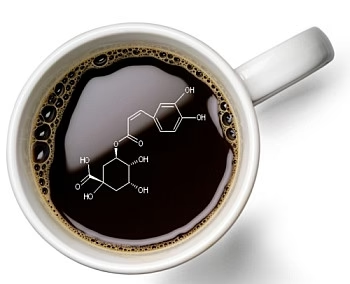
Chemically, the process intensifies. Sugars begin breaking down more aggressively, producing caramel-like compounds. Chlorogenic acids start degrading, reducing bitterness and contributing to brightness and complexity. Aromatic compounds multiply, giving rise to fruity, floral, and sweet notes.
First crack is not a single pop—it is a phase. It starts with the first audible sound, continues as a rolling series of cracks, and ends when the popping slows and stops. This phase marks the beginning of true flavor development.
Navigating Roast Development
From the start of first crack to the end of the roast lies the most critical period: development.
Dropping the coffee shortly after first crack produces a light roast, often called a City roast. These coffees highlight origin characteristics—bright acidity, fruit notes, and complex aromatics.
Extending development slightly creates a City+ roast. This adds sweetness and body while maintaining clarity and balance.
Pushing further leads to Full City roasts, where caramelization deepens. Chocolate, nutty, and dried fruit notes emerge, and acidity softens. These profiles are commonly used for espresso blends and broader appeal.
Each stage represents a trade-off. The longer the development, the more the roast influences the flavor, and the less the origin shines through.
Second Crack: The Threshold
Second crack is a different kind of signal.
Where first crack sounds like popcorn, second crack is sharper, faster, and more brittle. It typically occurs at higher temperatures and represents a new phase of structural breakdown.
At this point, the bean’s internal walls—already weakened—fracture again under pressure. Oils begin migrating to the surface, giving the beans a glossy appearance.
Chemically, this is where pyrolysis accelerates. Sugars are no longer just caramelizing—they are breaking down into carbon-heavy compounds. Fruity and floral notes diminish, replaced by smoky, bitter, and dark chocolate flavors.
Second crack narrows the margin for error dramatically. A difference of seconds can push a roast from rich and bold into harsh and overdeveloped.
The Cost of Going Dark
Roasting into second crack is not inherently wrong—it is simply a stylistic choice.
Dark roasts emphasize body, intensity, and bitterness. They reduce acidity and highlight roast-driven flavors rather than origin characteristics. This style is often used for traditional espresso profiles and certain brewing methods.
However, the deeper the roast goes, the less the coffee reflects where it came from. At extreme levels, nearly all nuance is replaced by the taste of the roast itself.
Consistency also becomes more difficult. The rapid progression of second crack leaves little room for correction, making control and timing essential.
Practical Decision-Making During the Roast
Successful roasting is not just about understanding theory—it is about making real-time decisions.
Sound is the most immediate feedback. A strong, even first crack suggests consistent heat and proper development. An uneven or weak crack can indicate issues earlier in the roast.
Timing is equally important. Tracking how long it takes to reach first crack, and how long development lasts afterward, allows for repeatability.
Rate of rise—the speed at which temperature increases—is another key variable. A controlled decline in this rate as the roast approaches first crack helps prevent defects and ensures even development.
Visual cues also matter. Color progression, bean expansion, and surface texture all provide valuable information. Aroma evolves alongside these changes, shifting from sweet and bread-like to rich and eventually smoky.
Experienced roasters combine all of these signals—sound, time, temperature, color, and smell—into a cohesive decision-making process.
Building a Repeatable System
Consistency separates good roasting from great roasting.
Most professionals rely on detailed logging. Recording charge temperature, time to first crack, development duration, drop temperature, and weight loss creates a framework for repeatability.
The cracks serve as markers. The data provides the roadmap.
With enough information, roasters can predict outcomes, adjust variables, and refine profiles with precision.
Listening to the Bean
First crack and second crack are not just milestones—they are communication.
They signal that the bean’s internal chemistry has reached a critical point. They tell the roaster when transformation is happening and when action is required.
Whether the goal is a bright, fruit-forward light roast, a balanced medium profile, or a bold, dark espresso, the foundation remains the same. The process follows consistent chemical principles. The difference lies in the decisions made along the way.
In the end, roasting is not about controlling the bean—it is about listening to it.
And the better you listen, the better the coffee in the cup.